Frequently Asked Questions
How many
coats are applied with powder coating?
Powder coatings are generally a one coat finish, applied to
suitable cleaned and pre-treated substrates. Some coatings, such as
metallics, require a clear coat to protect the metallic effect,
although these are generally being replaced with the Dulux Pearl
range which does not need a clear coat.
Can powder coatings be
applied on site?
Powder Coatings are a factory applied finish using specialised
equipment. The equipment includes an electrostatic spray gun, spray
booth and an oven to bake (or cure) the coating. On site
application is not possible given the hot curing cycle required to
fuse the coating.
Is
there an Australian or international standard for the correct
approach to powder coating?
There are various standards for powder application, covering the
correct procedure for pre-treatment, powder application, testing
and performance. The standards generally relate to the nature of
the substrate. For more information on standards, refer to the
Standards section of FAQ's.
Can powder
coatings be applied straight onto metals substrates?
Whilst powder coatings generally require no primers, it is
important to provide a clean and pre-treated surface for the powder
coating to adhere to. Metals that are planned for internal location
can escape the need for pre-treatment; however it is advisable to
provide some metal pre-treatment such as a phosphate finish to
steel or chromate finish to aluminium to ensure maximum performance
of the finish.
How long does powder coating stock
last for when kept in the carton?
Powder coating storage lives vary according to the technology
and the storage conditions. Generally Dulux recommend 2 years
before the powder is re tested to confirm no degradation in film
properties. If the powder has become lumpy and or absorbed
moisture, the material may be sieved and then fluidised for 10
minutes to condition the powder in preparation for application. If
the powder has become too lumpy and solid, it would suggest some
pre reaction of the powder which cannot be reversed nor corrected.
Some technologies may have shorter storage periods, but these are
generally outlined in the technical data sheets and / or product
packaging. The same conditions for re testing the powder apply as
above.
How do I maintain and refurbish
a powder coated surface?
The effects of pollution, dirt, grime and salt deposits can all
accumulate on a powder coated surface over time. To extend the
effective life of powder coatings and fulfil any warranty
requirements that may exist, a simple regular maintenance program
should be implemented for the removal of residues. As a general
rule, all powder coated surfaces should be cleaned every six
months. However, in areas where pollutants are more prevalent,
especially in coastal or industrial regions, a cleaning program
should be carried out on a more frequent basis. To clean a powder
coated surface, customers should carefully remove any loose
deposits with a wet sponge and then use a soft, non-abrasive brush
or cloth in combination with a mild household detergent solution to
remove dust, salt and other residues. Finally rinse all powder
coated surfaces with clean water.
What considerations should I make when
choosing a colour? Are there good and bad colour selections?
Not all colours behave the same during application or
performance on site. In general, light colours are ideal for more
applications than other colour groups.
Light colours absorb little light because the white pigments
help reflect the light. This reduces the heat up effect on parts.
Dark colours absorb light and hence heat far more readily, which
explains why dark cars are hotter than white cars in the sun. If
heat is an important element in the design or use of your product,
the effects of light and dark colours is important
consideration.
Bright colours behave differently again. Bright colours not only
absorb light and remit this as brightness, but the pigments are
more readily damaged by the ultra violet light reducing the life of
the colour as we know that colour. Bright colours, which include,
reds, oranges, yellows, bright greens and blues are recommended for
applications where colour retention is not critical such as
playgrounds and furniture.
It is possible to get very good durability out of bright
colours, but the very high expense of these pigments limits the use
of these products to automotive applications.
What is your stock
colour range?
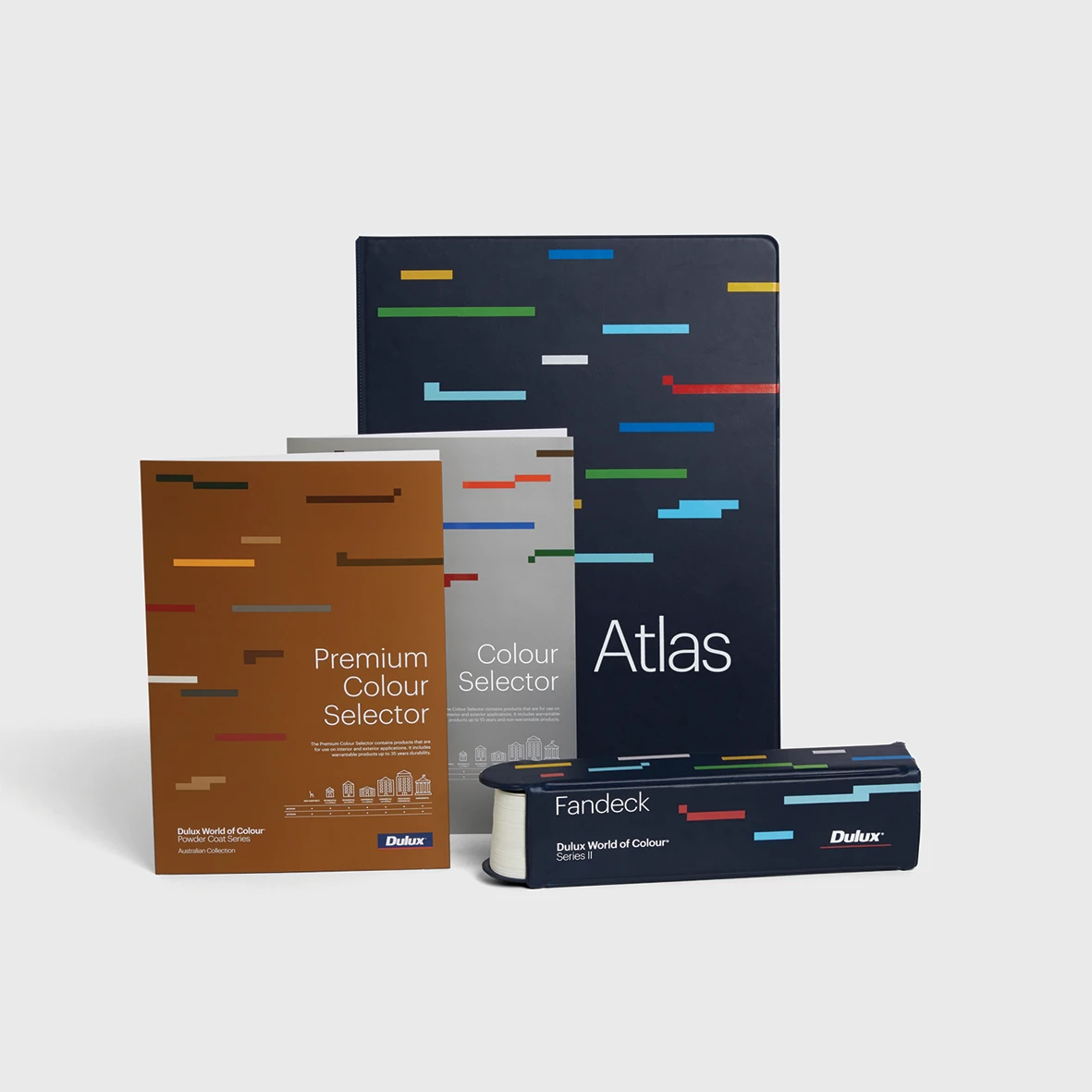
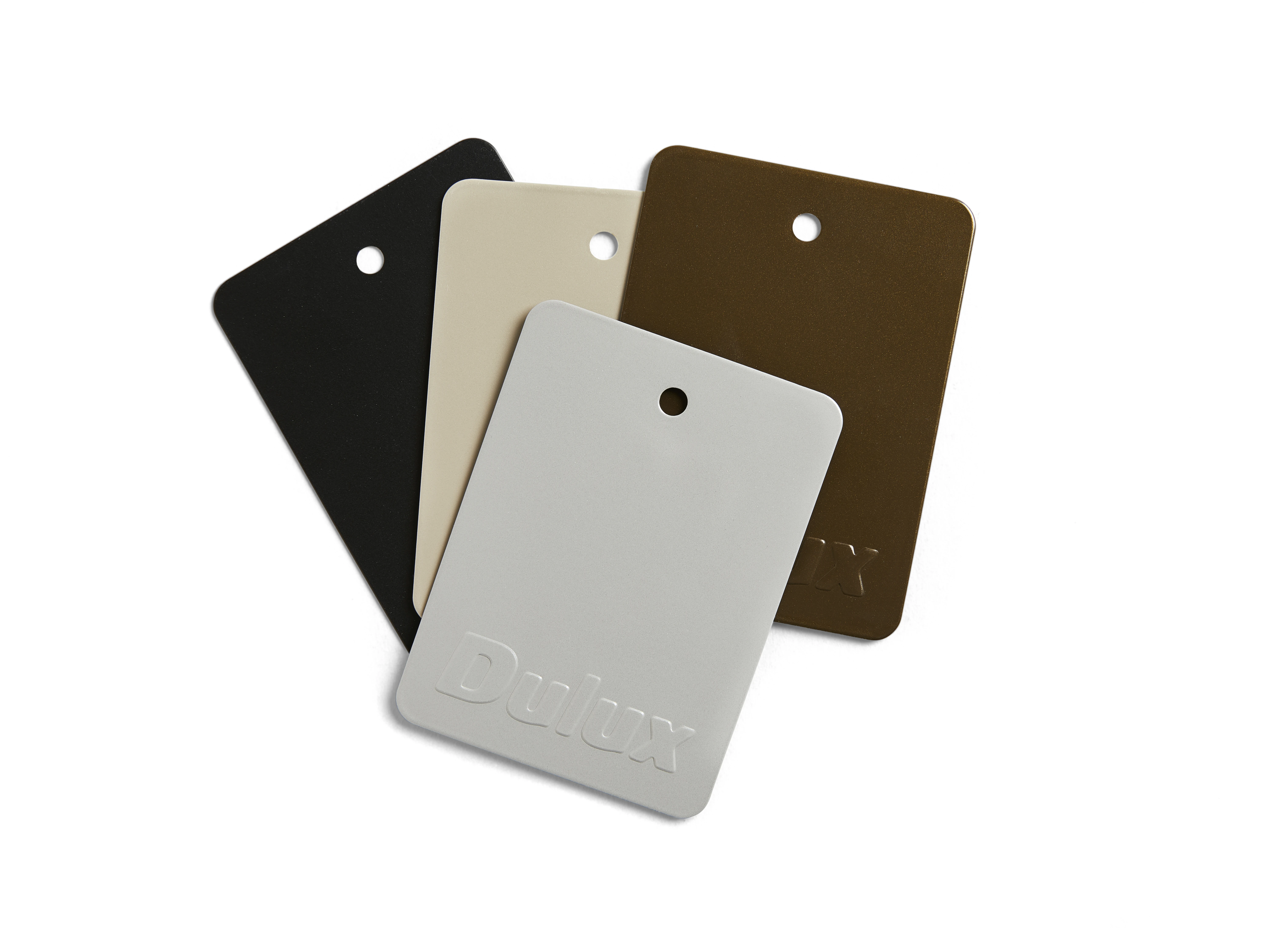
The Dulux Powder Coatings Colour Selector offers a range of over
120 stock colours in either matt, satin or gloss finish. Our colour
range includes colours to match the earthy tones of the BlueScope
Steel's Colorbond Roofing range in matt and satin.
Can I match a powder
coating to a paint colour?
Unlike paints which can be tinted to thousands of shades and
finishes, powder coatings are formulated and produced in a factory.
Powder coatings cannot be tinted successful since the solid
particles of each colour do not blend together, causing a mottled,
speckled look when two different colours are mixed together.
What is the best way to coordinate
colours between powder coatings and paints?
Dulux can produce special colours and finishes on a made to
order basis, but due to the nature of the manufacturing process,
minimum quantity conditions limit the possibility of special
colours to typically large or ongoing projects. It is recommended
that when choosing colour, the powder coating colour be chosen
first, as almost every powder finish can then be matched in a Dulux
paint system.
Why do some paint and powder
coatings share the same name but are entirely different
colours?
Paints and powder coatings have evolved from different
industries; house paints from the decorative applications and
powder coatings from industrial uses. Whilst Dulux has endeavoured
to align colour names across the industries, there are examples of
colours, such as Magnolia, which exist in both paints and powder
coatings, but are different in shade and strength.It is recommended
when choosing a colour that a colour sample of each product be
reviewed to ensure the colours chosen meet your needs.
How long do
powder coatings last?
This is a very common question. From the perspective of adhesion
and film integrity, correctly applied and pre-treated powder coated
metal can and has lasted since it was first applied more than 40
years ago.
Powder coatings are considered extremely resilient, be a coating
of choice for use on gas or oil pipelines which are buried in the
earth or underwater. Powder coatings are used on automotive and
appliances given their excellent chip resistance, hardness and or
chemical resistance.
From the perspective of resistance to light and UV degradation,
some powder coatings are outstanding, being used on major building
such as Duratec and Fluoroset FP.
The standard and most common powder coatings are designed for
general use and applications. Standard powder coatings offer good
weathering resistance, excellent film integrity and very good
hardness.
Is it true that
powder coatings can withstand any conditions and can even be
applied to rusty metal?
Unfortunately there is a myth that since powder coating is so
much easier to apply than wet paints, and retains a very hard film,
that powder coatings can withstand anything and everything. Indeed
this carefree view has led to some disappointing applications of
powder coatings.
Powder coatings rely on a clean, pre-treated surface like any
and every other coating. Rusty metal deposits must be removed prior
to powder coating, as over coating with powder will only mask what
is fundamentally corroding metal.
Powder coatings are terrific in resisting knocks and abrasions,
chemicals and the effects of the sun, but if not cared for, the
coating can show up scratches and perhaps film integrity loss.
Are
powder coatings suitable for use on surfaces which come into
contact with food?
Some powder coatings are designed specifically for contact with
food but this is a specialised application, and if this feature is
required, you should contact Dulux for further information. The
standard range of powder coatings are not suitable for contact with
food.
Do powder coatings
provide an electrical insulation characteristic?
Some powder coatings are specifically designed for electrical
properties, but again, as with food grade coatings, this is
specialised and you should contact Dulux for further advice.
How are powder coatings
manufactured?
Powder Coatings are produced by dry blending of resins,
pigments, additives and curing agents, which are then extruded at
elevated temperatures to melt and mix the ingredients. The material
then becomes thick and viscous like a honey mixture which is cooled
using super chilled water, before the material is crushed
progressively to a fine, well defined particle size. Specialised
equipment including rotary sieves and particle size measuring
equipment is used to monitor and control the particle size
distribution.
Where are
Dulux Powder Coating's manufactured?
Dulux has two production facilities for powder coatings supplied
to the local market. Our new facility in Dandenong South, Victoria
has four production lines with the capability of handling small
batch sizes. The second facility is located in Auckland, New
Zealand, which also has a variety of small and large size equipment
to cater for extensive range of products manufactured by Dulux.
Is there a
standard for the safe application of powder coatings?
Australian Standard AS3754 "Safe application by electrostatic
spray" outlines the procedures for safe application of powder
coatings. Copies of this standard can be obtained from your local
Standards Australia office.
Are powder
coatings classified as dangerous goods?
Powder Coatings are not classified dangerous goods. There are no
solvents in powder coatings which simplifies the transport and
storage of powder coatings.
Are powder coatings considered
environmentally friendly?
Everything is relative, and powder coatings are considered far
more environmentally friendly than wet paints or anodising. Powder
coatings use no solvents which are harmful to the environment. Over
sprayed powder can be recovered, sieved and then reapplied to other
products which helps reduce waste powder.
Whilst some municipal councils restrict the waste disposal sites
for powder coatings, the products have limited to no leaching
effect in dry form and no leaching effect in the cured form. Given
the very good durability of powder coatings, the need to recoat on
site is less common, meaning less burden on the environment into
the future.
What is the
process for cleaning up spilt powder coatings?
Powder coatings can be safely cleaned up via a brush and spade
or a vacuum cleaner, provided the amount of powder is not
excessive. For large spills, the powder should be shovelled into a
plastic bag inside a carton, and tipped into the box for easy
disposal.
What is the
correct procedure for disposal of powder coatings?
The rules and regulations for powder waste disposal vary across
states and regional councils. In many instances, powder coating is
suitable for land fill; however it is important to contact Local
Council and/or Environmental Protection Agency offices to clarify
local requirements for waste disposal.
As a rule, ensuring waste powder is placed in securely sealed
packs with no leaks is important to limit nuisance dust. This will
ensure that powder is not emitted to the atmosphere when loaded to
the waste truck on your premises and hence you will avoid
subsequent complaints from neighbours.
I have heard about
the practice of baking the waste powder inside the box and making
the powder go hard. Is it appropriate to heat the waste powder in a
box ready for disposal?
This practice has been used quite often in the industry, and the
rationale for reducing powder dust is admirable. However, placing
cardboard cartons inside ovens produces the risk of a fire which
can have devastating results.
There have been examples of fires at powder coating facilities
in Australia where operators placed waste powder cartons in the
oven which caused a fire. Aside from the loss of production and
equipment from fire, not to mention the safety risk to staff, most
insurance companies will not cover such incidents.
What precautions should we take
when handling powder coating?
Dulux recommend reference to the Australian Standard AS3754
"Safe application by electrostatic spray" for correct handling of
powder coatings. In general use of a dust mask, protective clothing
and/or barrier creams are recommended.
I know that mobile phones should be turned off in areas where there
is paints, solvents & petrol but are there any dangers with
mobile phones been around powder spray booths?
Whilst powder coatings have the advantage over solvent based
coatings of having a lower explosion point and therefore is less
flammable, caution should always be exercised with any electrical
source such as mobile phones. Powder coating is a fine organic dust
which in high concentration, in the presence of air and an ignition
source such as a mobile phone, could trigger a dust explosion.The
concentration of dust required to facilitate a dust explosion is
significant, however, it is advisable to keep unnecessary equipment
away from the booth and powder store. As a precaution, Dulux
recommends that mobile phones should be kept clear of these
areas.
What
is the most common international performance standard for powder
coatings?
There are various standards for powder coatings, depending on if
the aspect of the standard focuses on safe application, metal
finishing, and end use application such as coatings for children's
toys or quality test standards. This section of FAQ's outlines some
of the most common standards.
What is the recommended standard for
powder coating of aluminium?
For aluminium metals, Australian Standard AS3715 "Metal
Finishing - Thermoset powder coatings for architectural
applications" is recommended and most commonly referred to in
Australia. There are other standards which offer similar
conditions, criteria and performance features such as the British
Standard BS6496, but this standard is more commonly referred to in
Asia and abroad.
What is the
recommended standard for powder coating of steel and
galvanising?
For general metals including steel and galvanising, the
Australian Standard AS4506 "Metal Finishing - Thermoset powder
coatings" is recommended. The British Standard BS6497 has been
referred to quite considerably in the past as this deals directly
with the powder coating of galvanised metal substrates, and has
been in existence for much longer than the Australian standard
AS4506.
What
is a common standard for durability performance?
The most recognised standard for durability of coatings is the
AAMA standards. The AAMA standards are based on performance
criteria set out by the Architectural Aluminium Manufacturer's
Association, from where the reference to AAMA originates. The AAMA
standards cover 3 years Florida resistance (AAMA 2603-02), the 5
years Florida resistance (AAMA 2604-02) and the 10 years Florida
performance (AAMA 2605-02) which only Fluoropolymer coatings such
as Fluoroset and Fluoroset FP meet.
What are some standards which
outline some common performance test and quality assurance test
standards?
There are many standards established simply to outline an agreed
standard for measuring coating's performance. Examples of common
tests might be gloss measurement, adhesion of coatings, weathering
performance, hardness, chemical resistance or stain
resistance.Among the many standards are the Australian standard
series AS1580 and the British Standard series BS3900.
How can I
get a copy of the standards?
Copies of standards can be purchased from your local Standards
Australia office in major capital cities or by accessing one of
these appropriate websites.
Can you provide me with
an excel document of the colour names and RGB values as they
appear in the Colour Selector brochure?
Please feel free to download our colour names and RGB values by
clicking here.
Top of the page