Interior Preparation
Before you tackle your
paint job, it is important that you make sure you have the right
equipment. Taking shortcuts or using low quality equipment can cost
more time and expenses in remedial work.
Specific paint rollers, brushes and tools have been developed for
every painting application. Choosing the right equipment and using
the correct technique will result in a painting job that is faster,
cheaper and easier to use than alternative methods.
Painting equipment checklist:
* Recommended Paint Roller
* Matching roller frame
* Matching paint tray and tray liners
* 3 metre aluminium extension pole
* Synthetic Paint Brush 60mm (We recommend Selleys
brushes)
* Synthetic Paint Edger 38mm
* Drop Cloths
* Masking Tape
* Paint Mixer
* Paint Pads for varnishing
* Correct surface preparation filler
* Filling knife
* Sanding block and or pole sander
* Synthetic Paint Brush 60mm (We recommend Selleys
Spirit brush range)
Mould
Mould should be treated and removed before redecorating. To
remove mould, use a hypochlorite (household bleach) solution,
diluted 1 to 3 with water. Wear gloves and goggles to protect your
hands and eyes and protective clothing to protect skin from
splashes. Apply the solution with a thick scouring pad and highly
abrade the surface to ensure physical removal of any stubborn areas
of mould growth. Leave the solution on the surface for 15 minutes
then wash down thoroughly with clean water. If residual stains are
left, spot undercoat with Dulux Preplock Stain Blocker Shellac
Based. Mould grows in a particular environment. To discourage the
regrowth of mould, try to improve the ventilation in the affected
area. Recoat with Dulux Mouldshield Low Sheen or Semi Gloss when
redecorating to discourage the regrowth of mould.
Stripping woodwork
If the paint needs to be stripped back, the most common method
is to use a heat gun or a chemical stripper such as Selleys Kwik
Strip Smart. For small areas, a manual or drill mounted wire brush
or dry scraper may be adequate.
Removing wallpaper
You may choose to use a remover solution such as Polypaper Peel,
or hire a steaming machine. Newer vinyl wall covering can often be
peeled off dry by hand. They may leave a backing paper residue,
which can be removed by sponging on warm water and peeling it off
or scraping it with a broad-bladed scraper. Many types of
wallpaper, however, are less cooperative and may require scratching
with a very coarse sand paper to help the water or solution to
penetrate.
Preparing powdery, chalky and peeling surfaces
Paint that peels, or flakes away, from the surface, and is powdery
or poorly bound, should be removed.
The surface should then be cleaned thoroughly and when dry,
resealed with an oil based sealer such as Dulux Prepcoat Sealer
Binder. When repainting allow sufficient time for the Sealer Binder
to dry and cure if coating with an acrylic paint (water based) i.e.
2-3 days.
Painting over water stains
Firstly ensure that you know the source of the stains e.g.
water. Then check the adhesion of the existing paint by doing an
adhesion test refer 'Check if your old paint is sound' If the
existing coating is sound, you then need to wash the surface down
with sugar soap and allow to dry before applying Dulux 1 Step Oil
Based Primer Sealer Undercoat to "seal" the stain before applying a
topcoat.
Filling and Patching
There are a number of fillers that can be used to fill holes in
wood. Two products suitable for use on interior wood are Selleys
Plastic Wood and Polyfilla Ready to use Interior Timber. Simply
make sure the hole is clean and apply the filler with a spatula or
putty knife. Where movement is likely to occur, in places like the
joins between architraves and walls, a flexible filler such as
Selleys No More Gaps is recommended.
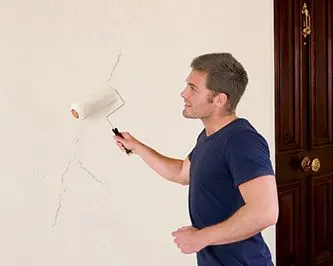
Filling holes in plasterboard or hard plaster is simple. Scrape
away any loose paint and plaster, and fill the hole using Selleys
Spakfilla Rapid.
If the edges of holes are cracked and unstable, a self-adhesive
patch will make the job easier. Larger holes in plasterboard will
need a patch inserted such as Polyfilla Patching tape. Cut away the
damaged section and use contact adhesive to put in wood or
plasterboard backing strips, then fix the patch onto the
strips.
A quick wipe with a damp sponge before the filler sets will take
out small ridges and save sanding time later.
Painting plasterboard
Remove all the dust from the surface by wiping down with a damp
cloth, apply one coat of Dulux 1 Step Acrylic Primer Sealer
Undercoat to the walls & ceilings. For the walls you can use
Dulux Wash and Wear 101 Advanced in the gloss level of your choice
and Dulux Ceiling White on the ceiling. Note: For a bathroom area
we would recommend Dulux Wash and Wear 101 Advanced Semi Gloss or
Aquanamel Semi Gloss. If your bathroom has a tendency to form mould
on walls or ceilings, then you should consider using Dulux
Mouldshield.
Sanding
Surfaces must be sanded smooth before paint is applied. Plaster
and patched areas should be sanded smooth with a medium then a fine
grade sandpaper. A coat of Dulux 1 Step Acrylic Primer Sealer
Undercoat should be applied to prepare the surface for the top
coat. New woodwork should be sanded with a medium grade sandpaper
in the direction of the grain and primed with one coat of Dulux 1
Step Acrylic Primer Sealer Undercoat or Dulux 1 Step Oil Based
Primer Sealer Undercoat to prevent tannin staining and provide
excellent adhesion. Previously painted surfaces, especially gloss
and semi gloss surfaces need to be sanded thoroughly to roughen the
surface so the paint forms a strong key for the new paint to adhere
to.
A final check
Before painting, give your work a final clean and check. Wipe
the walls thoroughly with a damp cloth and wipe the woodwork using
a cloth soaked in methylated spirits, to remove any remaining grime
or dust.
Dulux Facts
Always use masking tape around the edges of doors, skirtings and windows. Use a quality tape and remove it before the paint gets too dry.